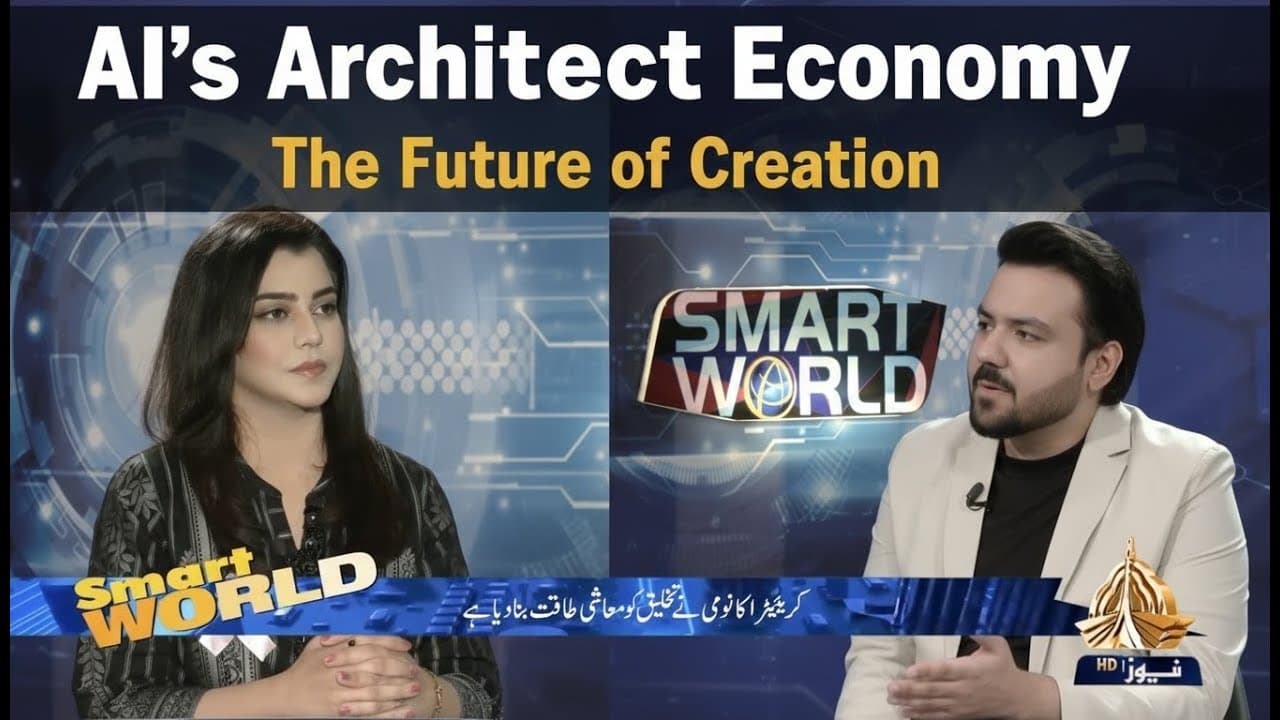
The Architect Economy: Why Builders Will Own the Next Decade
// 01. THE CREATOR ECONOMY WAS ALWAYS A TEMPORARY ARBITRAGE
When I said on PTV in 2024 that the Creator Economy is dead, people thought I was being provocative. I was being precise. The Creator Economy was never a structural shift — it was a temporary window where human attention was cheap, distribution was hard, and individual output had asymmetric value. That window is closed. AI closed it.
Think about what the Creator Economy actually rewarded: volume, consistency, and platform fluency. Write more. Post more. Optimize more. Those are operational skills, not architectural ones. And operational skills are exactly what AI does cheapest and fastest. When ChatGPT can produce a 1,000-word article in four seconds, the marginal value of a freelancer producing the same article in four hours collapses to zero. Not lower. Zero.
The economics are brutal and binary. If your output is replicable by a model, your income is on a countdown clock. Most content producers — freelance writers, video editors, prompt-for-hire consultants — are living on borrowed time and calling it a career. The Creator Economy did not democratize value creation. It democratized output. And now AI has democratized output further, at a cost that undercuts every human in the chain.
// 02. ARCHITECTURE IS NOT A METAPHOR — IT IS THE MECHANISM
When I talk about the Architect Economy, I am not using ‘architect’ loosely. I mean it structurally. An architect does not produce bricks — an architect designs the system that determines where every brick goes, why it goes there, and what it enables. That distinction is the entire point. The people who will own the next decade are not the ones who use AI tools more efficiently. They are the ones who build the infrastructure that other people run their AI tools on top of.
AI replaces tool users. It does not replace tool builders. The moment you confuse operating a platform with engineering one, you have already lost your seat at the table.
At BearPlex, we are a team of 65. None of our engineers are in the business of producing content. All of them are in the business of building systems — automated pipelines, SaaS platforms, data infrastructure, AI-integrated workflows for clients across three continents. That is architecture. We are not using the shovel. We are designing the mine. The distinction sounds philosophical until you look at the revenue model, and then it is very concrete.
Architecture compounds. Content depreciates. A blog post has a half-life measured in days. A well-engineered platform has a half-life measured in years. When you build infrastructure — whether that is a software product, an automated system, or a data pipeline — you are creating a structural asset that generates leverage over time. When you create content, you are generating a consumable that requires constant reproduction to maintain its value. One of these is a business. The other is a treadmill.
// 03. THE CAREER SHIFT NOBODY IS TALKING ABOUT CLEARLY ENOUGH
The conversation in most markets is still framed around AI as a tool for creators to use. Use AI to write faster. Use AI to edit video faster. Use AI to research faster. This framing is catastrophically wrong for anyone who wants to be economically relevant in five years. It positions AI as an amplifier of the creator model, when in fact AI is the terminator of the creator model. You do not amplify a paradigm that is being replaced. You exit it.
The career shift I am watching in real time: the smartest freelancers and content producers I know are not learning to use more AI tools. They are learning to build with AI — deploying agents, designing automated client workflows, building micro-SaaS products on top of model APIs. They stopped being operators and started being architects. Every single one of them has seen a revenue increase. The ones still optimizing their Upwork profiles have not.
This is not a skill upgrade — it is an identity change. The creator identity is built around personal output: my voice, my content, my audience. The architect identity is built around system output: what does my infrastructure produce when I am not watching it. That mental shift is harder than learning any technical skill. Most people will not make it. The ones who do will have a structural advantage that compounds every year as AI capabilities increase, because better AI makes better architects more powerful, not less necessary.
The path is not obscure. Learn to think in systems. Understand how APIs connect. Understand how data flows. Understand how automated pipelines reduce human-in-the-loop requirements. You do not need to be a senior engineer. You need to be someone who designs the workflow that the tools execute, rather than someone who executes the workflow that the tools could replace. The difference in those two sentences is the difference between relevance and obsolescence.
// 04. THE ARCHITECT ECONOMY IS A PARADIGM, NOT A TREND
Every major economic shift in history followed the same structural logic: the people who owned the infrastructure owned the era. The Industrial Revolution did not reward factory workers — it rewarded factory builders. The internet did not reward website visitors — it rewarded platform builders. The AI transition will not reward AI users. It will reward the people who build the systems, platforms, and pipelines that everyone else depends on to function.
What I am calling the Architect Economy is that paradigm, formalized. It is an economic environment where the dominant form of value creation is system design — not content production, not service delivery, not creative output. It is infrastructure. And infrastructure has a property that content does not: it scales without proportional human labor. That is the economic core of this entire argument. Architects build things that work while they sleep. Creators work to keep things alive.
My doctrine has always been that hype is a temporary tactic and architecture is a permanent advantage. The Creator Economy was hype — a decade-long moment where distribution was the bottleneck and human content production was the solution. AI removed that bottleneck permanently. What remains, what always remains after hype clears, is the question of who built something real. In the Architect Economy, the answer to that question determines everything. Build the system. Own the decade.
Continue the
Conversation.
Follow for real-time architectural thinking, investment signals, and unfiltered takes.
LET'S CONNECT→